Song & Original Writing · Written by Sean Michaelson
Original Writing: October 15, 2026 · Song Version: October 15, 2026
Original Writing
I’ve been thinking about three sentences that have meant more to me than I could possibly explain.
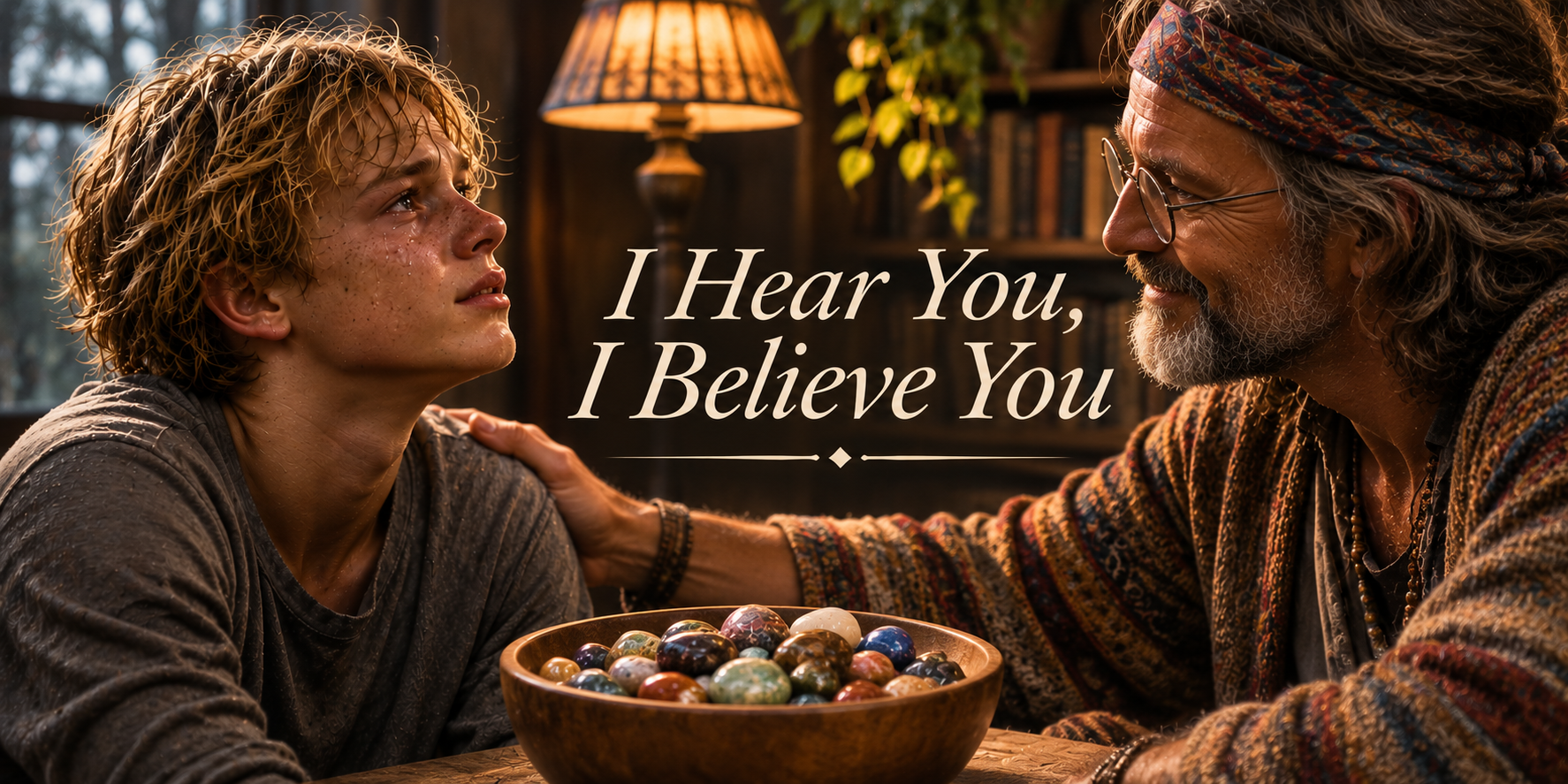
I hear you. I believe you. You are not alone.
They sound so simple, don’t they? Things we might say to comfort someone who is hurting. Things most of us would probably agree are important. But I’ve learned that there’s an enormous difference between saying those words and helping another person feel what they mean.
I was in my early twenties when I finally understood that difference. To explain why it mattered so much, though, I need to go back a little.
I was loved as a child. I want to make that clear because I think people sometimes assume that a childhood involving abuse must have been entirely devoid of love or happiness. Mine wasn’t. I knew affection, friendship, laughter, and moments of extraordinary happiness. There were people who cared deeply about me, and there are memories from those years I wouldn’t trade for anything.
I was also abused. Physically, emotionally, and sexually, although even that last word carries complexities I have spent much of my life trying to understand.
Both truths exist, and neither cancels the other.
I think we sometimes struggle to accept that. We want experiences to fit neatly into categories. We want to know who was loved and who wasn’t, who was harmed and who wasn’t, and what everything is supposed to mean. But a person can love someone who hurts them. They can be frightened of someone they desperately want to be close to. They can experience affection and violation in the same relationship, or spend years trying to understand feelings that seem impossible to reconcile.
There are experiences in my own life that I’ve examined for decades, turning them over and over, trying to understand them from perspectives I couldn’t possibly have had when they happened. Society has words for those experiences, words with definitions and assumptions
attached to them. Sometimes those words fit. Sometimes I struggle with them, not because I deny what happened, but because I remember more than a definition can hold. I remember what I felt, what I believed, what I wanted, what frightened me, and what confused me. Those things don’t always fit together comfortably.
I wonder how many other people carry experiences they cannot adequately describe. How many have remained silent because they don’t know what to call what happened? How many have tried to explain something, only to have another person immediately tell them what it means? I wonder how many have simply stopped talking because they were tired of having their own experiences explained to them.
For much of my childhood and early adulthood, I kept trying to tell people.
At nine, I spoke to adults at school and to a police officer at home. At twelve, I disclosed again to a therapist. At fourteen, I tried again with my parents. At sixteen, I was still searching for someone who could help me understand what I had experienced.
The years continued, and so did my attempts to find help. At eighteen, I was still trying. At twenty, I was still struggling. I kept reaching out, trying to explain things I barely understood myself, and too often I came away feeling unheard.
Every time that happened, I withdrew a little further. I became more isolated, more ashamed, and more convinced that perhaps I simply wasn’t important enough to help.
The different forms of abuse I experienced all carried their own weight. Physical abuse hurt me in ways that were different from emotional abuse, and the sexual experiences left behind complexities that were different still. I don’t want to pretend they were interchangeable, because they weren’t. But somewhere along the way, they began contributing to the same terrible belief about myself.
Worthlessness.
I’ve come to think of it as a circle of worthlessness. The more worthless I felt, the more I withdrew. The more I withdrew, the more alone I became. And the more alone I became, the easier it was to believe that perhaps I really didn’t matter.
Yet somehow, I kept reaching out. Even when I felt I had given up, some part of me was still looking for someone who might understand.
Eventually, I found Jim Struve.
Jim was a clinical social worker who specialized in childhood sexual abuse. I was in my early twenties when I began seeing him, and I still struggle to describe what those first experiences meant to me.
For the first time, I felt truly heard and believed. I began to understand what it meant not to be alone.
What made Jim extraordinary wasn’t simply what he said to me. It was what he did. He listened. He gave me room to struggle with feelings I couldn’t explain, without demanding that I immediately make sense of them. He was patient and compassionate, and I felt that he genuinely wanted to understand me.
And he collected rocks.
I know that probably sounds like a strange thing to mention in a piece about abuse, but those rocks were important to me. Jim collected and polished them, and he kept them available for the people he worked with. I could take as many as I wanted, whenever I wanted. Each stone had a meaning, something personal that helped create a sense of connection.
I wish I could remember those meanings. I remember how special they felt, though, and how something so simple could bring me comfort when I desperately needed it.
I took some of those rocks home. More than twenty years later, I still have them. They sit on the nightstand beside my bed.
Sometimes I wonder whether Jim could possibly have understood what those little stones would come to mean to me. They weren’t expensive or particularly remarkable objects. But they reminded me that someone cared enough to listen, that someone understood I needed more than explanations and advice, and that I didn’t have to figure everything out by myself.
What surprised me was how complicated being heard could feel.
It was exhilarating. The relief was enormous, sometimes almost overwhelming. Yet there were moments when it was terrifying. I had spent so many years feeling ashamed, isolated, and worthless that being genuinely understood challenged things I had come to believe about myself.
I wanted to be seen, but being seen frightened me. I wanted someone to understand, yet allowing someone close enough to understand made me feel terribly vulnerable. I wanted to believe I mattered, but sometimes that belief felt so unfamiliar that I struggled to accept it.
It was almost as contradictory as the abuse itself.
Jim didn’t make those contradictions disappear. He helped me begin to understand them. And he taught me something I’ve carried ever since. There’s an enormous difference between telling someone they aren’t alone and helping them experience what it means not to be alone.
That experience became an important part of what inspired this song.
What does it really mean to hear someone? I don’t think it simply means allowing another person to speak while we wait for our turn to respond. I think it means genuinely wanting to understand something outside our own experience, even when what we’re hearing is confusing or difficult.
Sometimes it means being comfortable with not knowing. God, that can be difficult. We want answers. We want explanations. We want things to make sense. But perhaps the person sitting across from us is still trying to make sense of it themselves.
I know what that’s like. Sometimes I needed someone to listen without deciding what my experiences meant before I’d even finished explaining them. I needed room to be uncertain, to change my understanding as I learned more, and to admit that I didn’t have answers to questions other people seemed to think should be simple.
Confusion isn’t dishonesty. Struggling to explain something doesn’t make it unimportant. And another person’s suffering doesn’t have to make perfect sense to us before we can care about it.
Then there are the words, I believe you.
I know what it feels like to tell someone something deeply personal and have them deny it. I know how devastating that can be.
I’ve also learned that believing someone involves more than accepting an account of events. It means taking the person seriously. It means recognizing that their experiences and feelings matter, even when there are things we don’t understand.
That doesn’t mean pretending we know things we cannot know or abandoning thoughtful questions. But there’s a difference between asking questions because we genuinely want to understand and asking them because we’ve already decided someone must be wrong.
I think people can feel that difference. I certainly can.
And then there are the words that may mean more to me than either of the others.
You are not alone.
I’ve thought about loneliness a great deal throughout my life. Some of the deepest loneliness I’ve experienced had very little to do with whether other people were around.
You can be sitting in a room filled with people who love you and still feel completely alone. You can have friends, family, a spouse, children, people who would do almost anything for you, and still carry something inside yourself that feels unreachable.
I know because I’ve experienced it.
For me, loneliness was often the belief that nobody could possibly understand what was happening inside me. It was the fear that if someone truly knew, they might see me differently.
And sometimes it was the experience of finally finding the courage to speak, only to feel that the person listening hadn’t understood me at all.
There’s a difference between being loved and feeling understood. Both matter, and I’ve been fortunate enough to experience both, though not always at the same time or from the same people.
I’ve known people who stayed, who listened, and who were willing to examine painful and complicated truths with me. People who didn’t need me to have everything figured out before they could care about me.
Those relationships have given me something I wish everyone could experience: the freedom to be completely human in another person’s presence. To be confused, angry, ashamed, frightened, or uncertain without feeling the need to apologize for it. To say something difficult without spending the next hour defending my right to feel it. To cry when I need to cry and laugh when something is funny, without worrying that someone will decide my pain couldn’t have been very serious after all.
I think that’s what I want these three sentences to represent. Not an empty reassurance or a promise that everything will be okay, but a willingness to be present.
I cannot fix what happened to someone else. I cannot undo a childhood, erase an act of violence, or give back the years someone spent struggling with experiences they never should have had to endure. I cannot promise that telling someone will make everything better. Sometimes telling is only the beginning of an extraordinarily difficult journey.
And I cannot promise that everyone will respond with compassion. I wish they would, but I know better than to make that promise.
What I can do is care. I can listen and try to understand. I can recognize that another person’s experiences belong to them, even when I recognize something of myself in their suffering. And I can remember that sometimes the most important thing I have to offer another human being isn’t an answer. It’s my willingness to remain beside them while they search for their own.
When I began imagining this song, I heard a single voice. One person speaking to another, quietly and gently, almost as though the words were being spoken to someone who was frightened they might not be welcome.
But as I continued thinking about it, I began imagining other voices joining in. I wanted the person listening to hear what it might sound like to be surrounded by people who genuinely cared.
I imagined people whose experiences were completely different recognizing something familiar in one another. A man who had never spoken about the abuse he experienced as a child standing beside a woman who had survived years of emotional cruelty. Someone who had been physically beaten standing beside someone whose wounds were never visible. Someone who had spent
decades questioning whether their experiences even qualified as abuse standing beside someone who had never doubted what happened but had spent a lifetime struggling with its consequences.
I didn’t imagine them comparing their suffering or deciding whose experiences mattered more. I imagined them recognizing one another.
More voices joined them. People of different ages, backgrounds, beliefs, and experiences. Some had found healing, while others were still searching. Some had told their stories a thousand times. Others had never told anyone, and some might never find the words.
Then I imagined the words changing.
Instead of one person saying, I hear you. I believe you. You are not alone, there were many voices answering together.
We hear you. We believe you. You are not alone.
I don’t know whether I’ll ever hear this song performed the way I imagine it. I don’t know how many people it will reach or what anyone will feel when they hear it.
But I know what I hope.
I hope someone who has spent years trying to explain something will feel understood, even if only for a few moments. I hope someone who has questioned whether their experiences were serious enough to matter will begin to see that suffering isn’t a competition. And I hope someone who has felt completely alone, even while surrounded by people, will recognize that others understand something about that loneliness.
Most of all, I hope they begin to recognize something about themselves that I spent much of my life struggling to believe.
That they matter. That they are wonderful, amazing human beings. That they are worthy of kindness, understanding, and love. That they are loved and, perhaps even more importantly, that they are lovable.
They don’t have to overcome everything or find the courage to tell their story to deserve those things. They don’t have to heal, forgive, or become someone different. Their worth was never something they had to earn.
Whatever happened to them, whatever they’ve come to believe about themselves, that worth was never taken away. They may have lost sight of it. They may have spent years believing it was gone.
I know something about that.
But it was never gone.
Maybe they’ll reach out to someone. Maybe they’ll speak about something they’ve never been able to say aloud. Or maybe they’ll simply listen to the song and sit with what they’re feeling for a while. I don’t think there has to be a particular response for those moments to matter.
There’s something else I hope, too. I hope people listening don’t hear these words only as something being offered to them. I hope they recognize that they can offer the same kindness to another human being.
Somewhere, there’s someone trying to find the words to explain something difficult. They may be frightened or ashamed. They may not understand their own experiences well enough to explain them, and we may not know what to say.
Perhaps all we can do is listen and let them know we care.
Or perhaps we can offer something as simple as a little polished stone.
I still have those rocks beside my bed. After all these years, they remind me of a man who did far more than tell me I mattered.
He helped me begin to believe it.
I think about how different my life might have been if I’d never met Jim, and I wonder how many people are still waiting for someone like him. Someone who will listen without rushing them, take their experiences seriously, and help them feel less alone.
I can’t be Jim Struve for everyone who hears this song. But I can try to offer something of what he gave me, and I hope others will do the same.
Because those three sentences were never meant to be extraordinary words. They were meant to express something every human being deserves to experience.
I hear you. I believe you. You are not alone.
Song Lyrics
I Hear You, I Believe You
[Verse 1]
I know the weight of holding secrets,
The fear of letting someone see,
The thousand words you never speak,
The pain you carry silently.
I know what it’s like to tell the truth
And watch somebody turn away,
To wish that someone, just one person,
Would believe the words you say.
And I won’t ask you to explain it,
Or tell me why you couldn’t speak.
You don’t have to prove your suffering,
You don’t have to be strong for me.
[Chorus]
I hear you,
I believe you,
You are not alone.
You don’t have to hide your tears,
You don’t have to face this on your own.
What happened wasn’t yours to carry,
You deserved a different story.
And if the world has turned away,
There’s something I need you to know.
I hear you,
I believe you,
You are not alone.
[Verse 2]
Maybe someone stole your childhood,
Maybe home was where you feared,
Maybe every time you cried for help,
Nobody seemed to hear.
Maybe words became the weapons,
Maybe bruises never showed,
Maybe someone made you question
Every truth you’ve ever known.
And maybe you’ve spent years believing
That somehow you were to blame,
But someone else’s cruel decisions
Do not make you theirs to shame.
[Chorus]
I hear you,
I believe you,
You are not alone.
You don’t have to hide your tears,
You don’t have to face this on your own.
You were worthy of protection,
Of kindness, love, and understanding.
And nothing anyone has done
Can take away the worth you hold.
I hear you,
I believe you,
You are not alone.
[Bridge Building]
For every child who wasn’t heard,
For every truth somebody denied,
For every soul who learned to smile
While hiding all the hurt inside.
For everyone still searching
For the words they cannot find,
For those who aren’t ready to speak,
Or are still trying to survive.
You don’t owe the world your story.
You don’t have to earn your place.
You deserve to be treated gently,
You deserve to feel safe.
And if all that you can do today
Is make it through another night,
That doesn’t mean you’ve failed at healing.
You are still deserving of a life.
[Final Chorus]
We hear you,
We believe you,
You are not alone!
Every voice that once was silenced
Deserves the chance to be known.
You are more than what they did to you,
More than all the hurt you’ve known.
Your story isn’t theirs to own,
Your life is still your own!
We hear you,
We believe you,
You are not alone!
[Outro Gentle, Intimate]
And if tomorrow feels too heavy,
You don’t have to find the words.
You don’t have to share your story
Just to know that you deserve to be heard.
I hear you.
I believe you.
And you are not alone.
Listen to the Song
About the Music
Note: The music and vocal performance for this song were generated using AI tools. The original writing and lyrics were written by me (Sean Michaelson). My hope is to someday collaborate with musicians and vocalists to bring these songs to life in a deeper and more personal way.

